
Initial Challenge
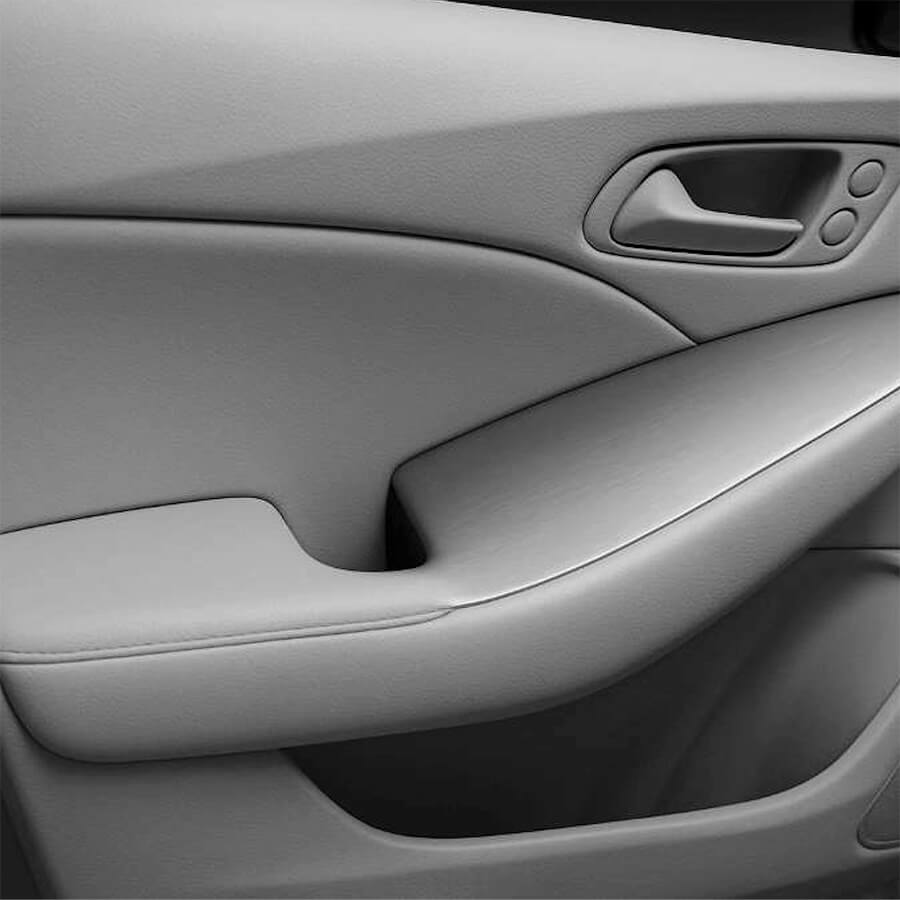
The client aimed to create a sleek, metallic-looking surface that remained completely clean and featureless when inactive, yet transformed into an intuitive control interface when approached.
A key technical obstacle was the incompatibility of true metallic surfaces with capacitive touch sensing. In metals, the entire surface acts as a single conductive plane, making it impossible to electrically isolate individual sensing zones, which are essential for distinguishing discrete buttons or gestures.
Therefore, the challenge was twofold:
-
Maintain the premium metallic aesthetic the client desired.
-
Implement a multi-zone interactive interface that could detect proximity and touch without relying on physically separate electrodes on a conductive material.
This required an innovative material and sensor integration strategy that emulated metal visually, while remaining compatible with fine-grained capacitive control.
Proposed Solution
Kentia Engineering supported with the development of a solution that enabled interactive functionality without compromising the clean, metallic look of the surface.
This was achieved by applying a physical vapour deposition (PVD) coating to a plastic substrate. This gave the part the appearance of real metal while retaining the electrical properties necessary to support localised interaction zones. This was key to discretising areas that would otherwise be electrically continuous on a real metallic surface.
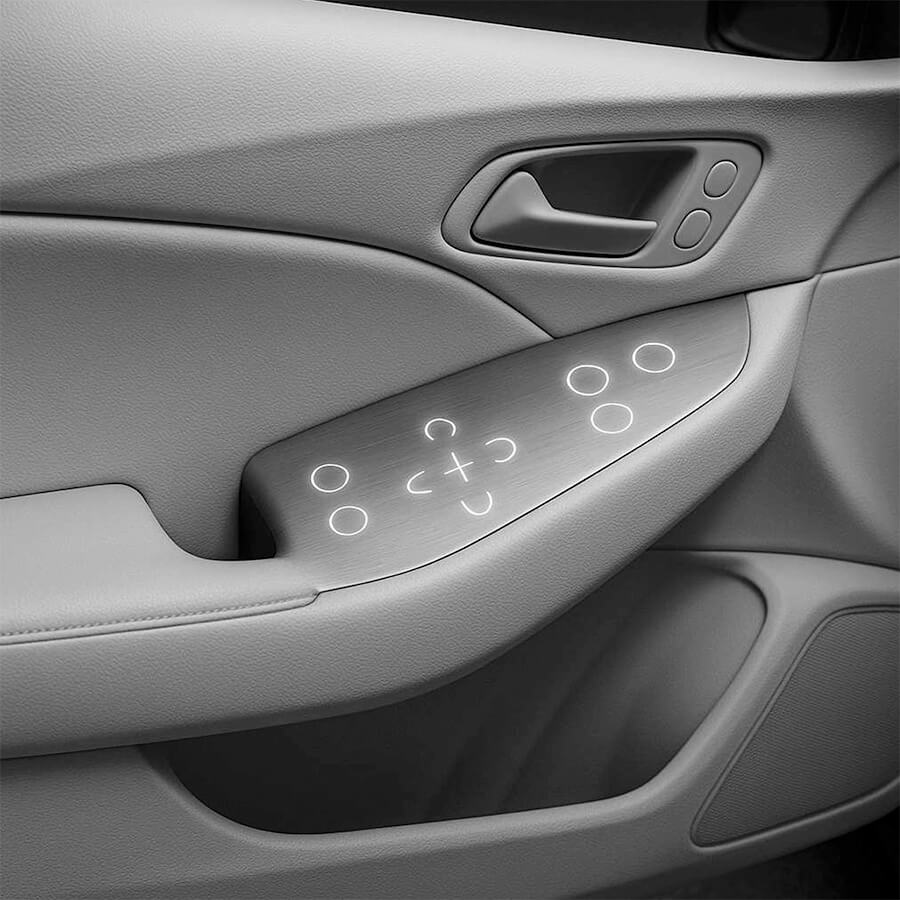
The visual interface remained completely hidden when inactive. When the user approached, discrete lighting zones were activated, revealing the available control areas in a smooth, user-friendly manner. These zones allowed intuitive control of features such as light colour and speaker volume.
To ensure seamless mechanical integration into the final assembly, the electronics were implemented on a flexible printed circuit board. This allowed them to adapt to the complex surface geometry and reduce packaging constraints.
Results and Achieved Benefits
-
Invisible interface: when not in use, the surface appeared as a flawless metal-like panel with no visible buttons or lights.
-
Selective activation: upon hand proximity, discrete visual cues illuminated, guiding the user intuitively toward interaction zones.
-
Multifunction control: users could intuitively adjust lighting color and speaker volume through the concealed interface, enhancing the perceived sophistication.
-
Design integrity maintained: the solution preserved the metal-look finish while enabling functionality impossible with real metallic surfaces.
-
Improved user experience: the combination of visual feedback, hidden technology, and seamless activation created a clean, elegant, and highly usable interface suitable for high-end applications.
-
Manufacturing-ready: the approach ensured compatibility with automotive interior standards and was adaptable to existing production workflows.
Lessons Learned and Best Practices
-
Improved HMI interaction: an intuitive solution in a mechanical component similar to digital devices.
-
Part with an attractive aesthetic finish when not in use, where the different functions are subsequently displayed.
-
Fully integrated solution: no gaps or spaces between elements.
-
Elimination of physical buttons, with a 0% failure rate for capacitive buttons.
Interested in enhancing your product with seamless, smart surfaces? Let Kentia Engineering help you develop the next-generation user interface in automotive and beyond.